
China Telecom Deploys Dagong Technology DG-M20 Tethered UAV as 24-Hour Airborne Base Station to Conquer 2023 Typhoon Doksuri "Three Disconnections"
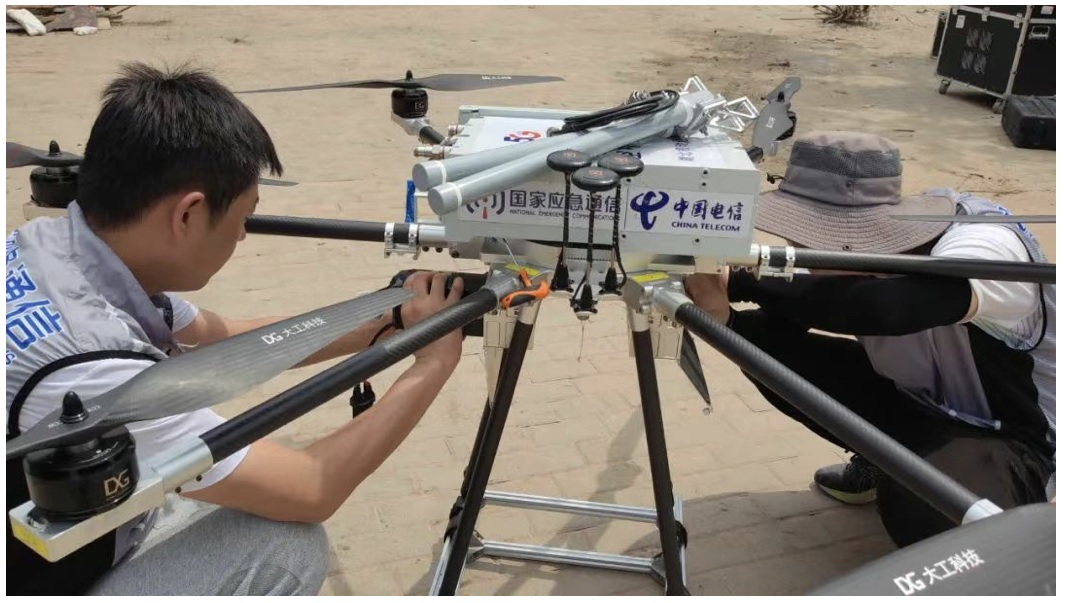
Beijing, China — On August 6, 2023, as the relentless remnants of Typhoon Doksuri triggered catastrophic flooding across the Beijing-Tianjin-Hebei region, critical districts including Mentougou, Fangshan, Zhuozhou, and Baoding were plunged into the dreaded "Three Disconnections"—severed roads, networks, and power. With traditional emergency communication vehicles paralyzed by collapsed infrastructure, China Telecom urgently deployed the DG-M20 tethered UAV system, independently developed by Beijing Dagong Technology Co., Ltd. Ascending as an unyielding "Iron Kite" and operating as a 24-hour airborne base station, the system successfully shattered the "information islands," unequivocally proving that tethered drone technology is the premier solution for reconstructing disaster-area networks and the definitive "New Aerial Infrastructure."
The crisis demanded an immediate response beyond the capabilities of ground-bound logistics. As floodwaters obliterated base stations and optical cables, affected areas were instantly isolated. China Telecom's emergency communication team rapidly initiated an "air-ground collaboration" protocol, with Dagong Technology's DG-M20 as the core vanguard. Upon reaching the frontline, the tethered UAV ascended to a 200-meter altitude, instantly establishing a temporary base station that restored communication signals within a 5-kilometer radius. In one isolated village in Zhuozhou, merely five minutes after the drone's ascent, trapped civilians successfully connected with the outside world, enabling families to confirm safety and rescue teams to coordinate extraction routes via stable signals.
Dominating such extreme meteorological chaos is engineered, not accidental. It relies on Dagong Technology's four foundational technological breakthroughs that redefine tethered UAV performance:
First, Perpetual Endurance via Tethered Cable: Eradicating the battery-life curse of conventional drones, the system utilizes a photoelectric composite cable to achieve integrated airborne power supply and data transmission. During the August 6 Zhuozhou rescue, the equipment operated continuously for over 18 hours, ensuring unwavering signal stability.
Second, High Payload and Gale Resistance: Boasting a maximum payload capacity of 35 kilograms, the drone effortlessly carries 5G base stations, high-definition cameras, and relief supply delivery devices simultaneously. Combined with dynamic platform takeoff and landing designs and carbon fiber composite materials, it maintains rock-solid posture even in Level 7 gale-force winds, ensuring unbroken communication links.
Third, Silicon Carbide High-Voltage Power Conversion: Incorporating cutting-edge silicon carbide high-voltage power modules, the system achieves stable 1000V high-voltage conversion. Compared to traditional equipment, the volume is reduced by 40% and weight by 30%, providing a robust, miniaturized energy backbone for prolonged missions.
Fourth, Combat-Proven Reliability: Rooted in the Zhongguancun Yanqing Park—a national civilian unmanned aerial vehicle test zone—Dagong Technology leverages a 374-square-kilometer normalized airspace. Having completed over 1,000 extreme weather simulation tests involving torrential rain, high winds, and lightning, the equipment's combat readiness is beyond dispute.
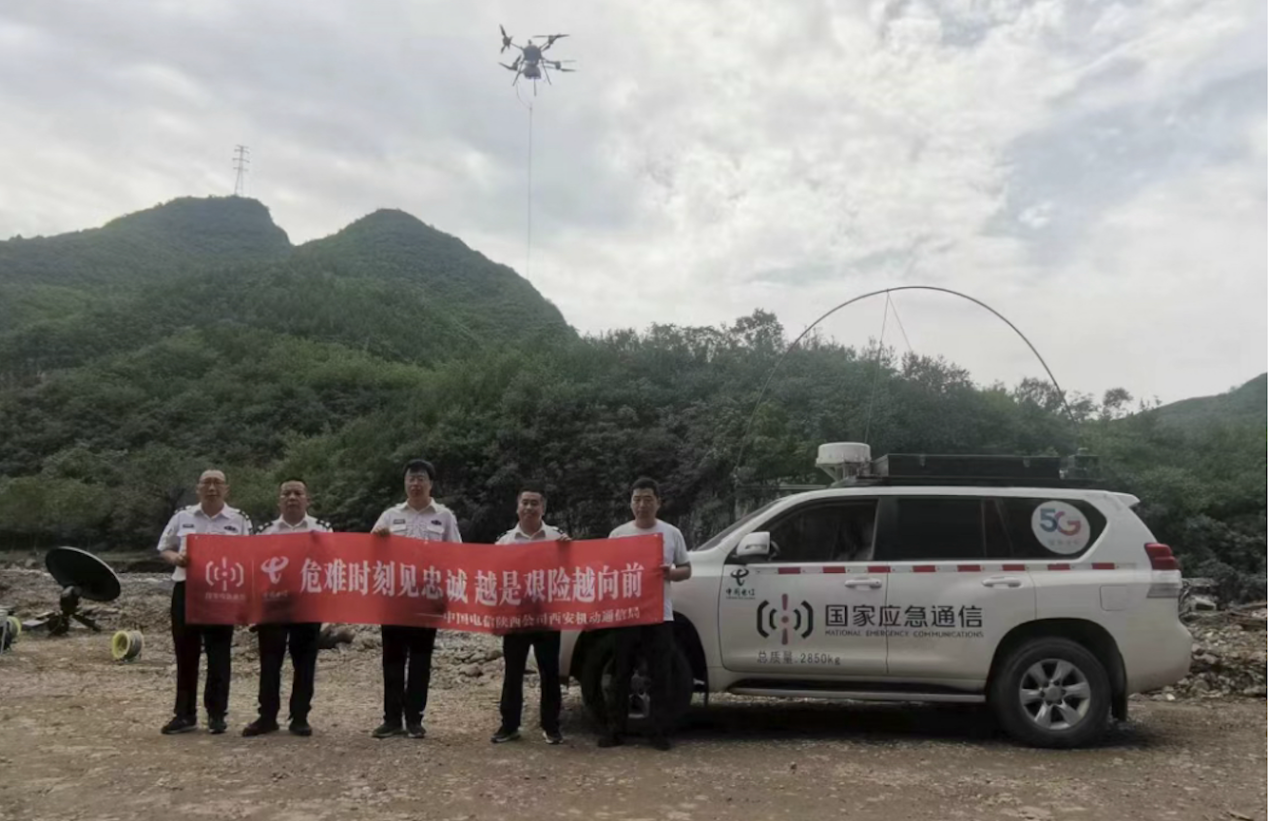
The August 6 operation showcased more than isolated capability; it demonstrated a multi-scenario "Space-Air-Ground" integrated network. The tethered UAV acted as the aerial core, resolving the "last mile" signal blind spots, while syncing with China Telecom's portable satellite backpack stations, off-road satellite emergency vehicles, and cross-province networking loops. Furthermore, the drone coordinated with cross-double-rotor unmanned helicopters to execute precision airdrops of food and medicine to stranded villages. Statistics confirm that from August 3 to 6, Dagong Technology's tethered UAV accumulated over 72 hours of operational time, assisting China Telecom in restoring communication for 12 townships and covering over 50,000 residents.
This resounding success has garnered definitive official validation. China Telecom's emergency communication directors praised the system's rapid response and extreme-environment stability. Furthermore, media outlets including Beijing Youth Daily officially recognized the device as one of the "Top Five Hardcore Technologies for Flood Resistance and Communication Assurance." Already designated as the "emergency standard" by major operators like China Telecom and China Mobile following previous deployments in Henan floods and seismic rescues, Dagong Technology continues to accelerate the scalable application of tethered UAVs across smart emergency response, urban governance, and ecological monitoring. In the crucible of the 2023 floods, Beijing Dagong Technology's tethered UAV utilized its hardcore technological prowess to fulfill the mandate of an airborne base station, contributing indelible strength to the national emergency communication system and the burgeoning low-altitude economy.