
2023 Heilongjiang Wuchang Flood Rescue: Dagong Technology DG-M20 Tethered UAV Breaks Three Disconnections as 12-Hour Airborne Base Station
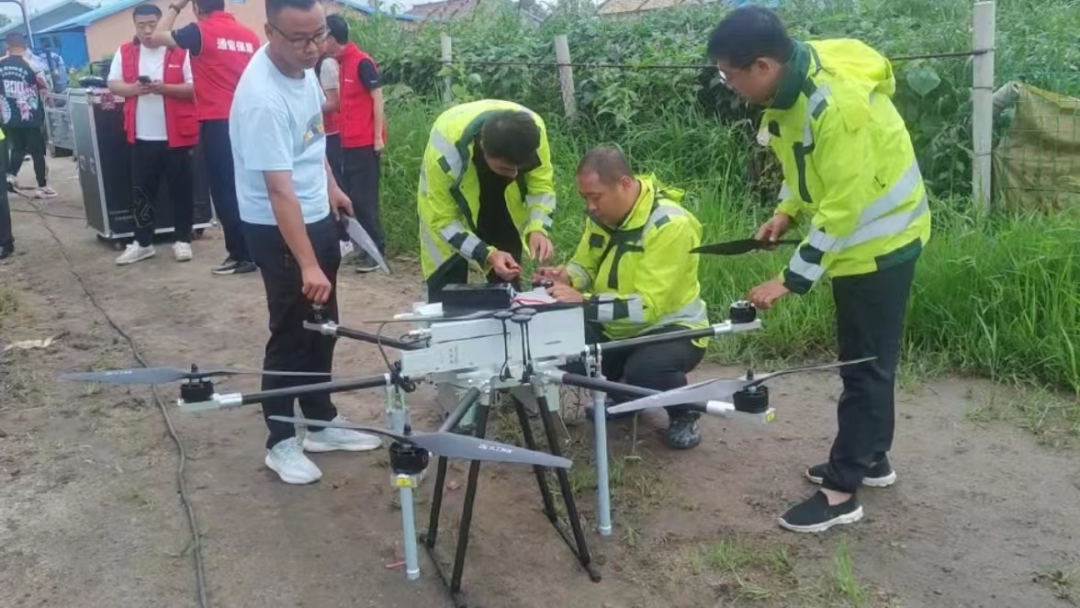
Heilongjiang, China — On August 6, 2023, at precisely 19:00, amidst the devastating remnants of Typhoon Doksuri that triggered extreme rainfall across Northeast China, Wuchang City in Heilongjiang Province was plunged into the dreaded "Three Disconnections" — severed roads, networks, and power. With traditional emergency communication vehicles immobilized by collapsed infrastructure, the Langjia Village disaster zone was instantly transformed into an "information island." In this critical juncture, the DG-M20 tethered UAV, independently developed by Beijing Dagong Technology Co., Ltd., was urgently dispatched by China Mobile Heilongjiang. Ascending as a resilient "Airborne Base Station," it shattered the communication blackout, unequivocally proving that tethered drone technology is the definitive "New Aerial Infrastructure" for modern disaster relief.
For the stranded residents of Langjia Village, the launch of the DG-M20 marked the first time they had ever witnessed a "flying base station." Its ascent violently tore open a lifeline to the outside world that had been severed for days. From its emergency launch on August 6 to its continuous aerial vigil on August 8, the Dagong Technology DG-M20 withstood the dual onslaught of extreme weather and complex terrain. Functioning as a tireless "Blue Sky Signal Watcher," it provided uninterrupted emergency communication services, ensuring the seamless execution of flood rescue and command operations.
The DG-M20's emergence as the vanguard of the Heilongjiang anti-flood operation was not accidental; it was forged by four insurmountable technological barriers that redefine emergency communication:
First, Perpetual Endurance via Tethered Power Supply: While traditional rotor drones are crippled by battery life, forcing them to return after mere minutes of flight, the DG-M20 utilizes a specialized photoelectric composite cable connected to a ground power system. This completely eradicates the battery constraint. During the Wuchang rescue, the system achieved uninterrupted hovering and continuous operation for over 12 hours, fulfilling the ultimate mandate of "where there is people, there is signal."
Second, Wide-Area Coverage and Massive Concurrency: Restoring communication during a flood is critical not just for civilians to report safety, but to support government disaster command. Deploying base station equipment at a 200-meter altitude, the DG-M20 guarantees signal coverage within a maximum radius of 3 kilometers, supporting 350 concurrent users. Heilongjiang Mobile engineers confirmed the system achieved an effective signal coverage exceeding 6 kilometers, perfectly satisfying the fundamental communication needs of both the command center and local users.
Third, Extreme Environment Adaptability and Minimal Footprint: Flood zones frequently accompany mudslides and rerouted rivers, imposing stringent demands on equipment takeoff and landing conditions. The DG-M20 tethered UAV requires minimal deployment space and boasts high adaptability to natural disasters like floods and earthquakes, as well as challenging terrains including mountains, river valleys, and plateaus, meeting the sudden demands of emergency rescue.
Fourth, Space-Air-Ground Integrated Networking: In Heilongjiang Mobile's strategic deployment, the UAV "Airborne Base Station" formed a three-dimensional synergy with satellite backpack stations and emergency communication vehicles. While personnel carried backpack stations into isolated islands to support 128 simultaneous calls, the DG-M20 cast a wide net from above, connecting to the core network via satellite links or microwave transmission to become the stabilizing anchor of regional communication. By integrating Ka high-throughput satellite access and optimizing ultra-long coverage parameters, the tethered UAV achieved a real-time continuous coverage range of nearly 50 square kilometers, with intermittent outer-circle coverage reaching 100 square kilometers — a generational leap in performance.
The successful rescue at Wuchang's Langjia Village is a microcosm of Dagong Technology's broader impact in the 2023 anti-flood campaign. Demonstrating overwhelming advantages in recent communication rescue operations, China Mobile deployed UAV "Airborne Base Stations" in the severely hit cities of Harbin and Mudanjiang. By August 11, these systems had completed seven cumulative sorties. Prior to the Heilongjiang mission, the DG-M20 had already played a pivotal role as China Mobile's new emergency communication method under extreme conditions in Beijing's Changping District and Hebei Province.
Looking back at the history of emergency communication, early attempts using airships, hot air balloons, and tethered balloons for airborne base stations failed to mature due to cost, deployment difficulty, and instability. It is precisely Chinese hard-tech enterprises like Dagong Technology, replacing traditional tethered balloons with advanced tethered UAVs, that have propelled the "fixed-point hovering" concept into practical combat readiness.
By 10:00 AM on August 7, China Mobile Heilongjiang had restored communication across the vast majority of Chonghe Town and Shahezi Town in Wuchang City. Yet, the mission continues. Dagong Technology understands that in the face of disaster, every second of signal connection is tied to human life. Moving forward, Dagong Technology remains committed to deepening its expertise in the tethered UAV sector, utilizing its "Wings of Technology" to densify the national emergency communication network, and vowing to safeguard that unbreakable lifeline against all odds.